
May 13, 2027: Is Your Business Really DPDP Compliant?
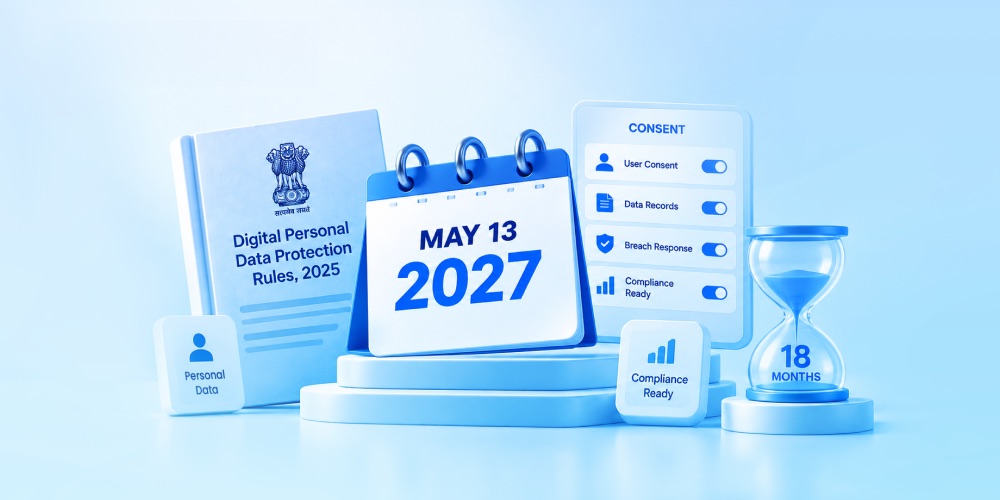
Mark that date. Not because it's dramatic, but because it's arithmetic: 18 months from 13 November 2025, when the Ministry of Electronics and Information Technology notified the Digital Personal Data Protection Rules, 2025 under Gazette Notification G.S.R. 846(E). By that date, the core compliance obligations under India's data protection framework apply to most businesses that collect personal data - which, in practice, means most businesses operating in India today.
Most companies currently answer the compliance question with a feeling rather than a fact. "We're probably fine" is not the same as "we checked." This article is built to close that gap - walking through exactly what May 13, 2027 requires, what's already true before that date arrives, and how to find out - honestly, not optimistically - where your business actually stands.
Why This Specific Date, and Not Some Vague "Soon"
The Digital Personal Data Protection Act, 2023 was passed by Parliament years before it could be enforced, because a law without implementing rules has no mechanism to actually operate. The Rules notified in November 2025 changed that - and they came with a specific, calculable runway rather than an open-ended "eventually."
Three milestones run in parallel, and businesses that only track one of them are working from an incomplete picture.
| Milestone | Effective Date | What It Covers |
|---|---|---|
| Data Protection Board set up | 13 November 2025 | The Board's establishment and operating Rules are in force; its inquiry and penalty powers apply from the 18-month mark |
| Consent Manager registration and obligations | Approximately 13 November 2026 | Licensed consent intermediaries must be fully compliant |
| Core Data Fiduciary obligations | 13 May 2027 | Notice, consent, breach reporting, and security duties apply to most businesses |
The date in this article's title is the third row - the one that determines whether an ordinary business, not a specialized consent-management company, is operating legally. But treating it as the only date that matters ignores the fact that the regulator overseeing your eventual compliance will have had a year and a half to get set up by the time this deadline lands. For the full timeline, including what the Board can and can't do yet, see The Compliance Deadline Nobody's Talking About Enough.
What "Compliant" Actually Means on That Date
Being compliant by May 2027 isn't a single checkbox - it's a set of specific, testable requirements. Here's what a genuine yes looks like for each one.
Your consent notice stands on its own. A compliant notice explains, in plain language and without referring to a separate document, exactly what personal data is being collected and for what specific purpose. If your current version is a link to a long-form privacy policy, that's not yet compliant.
Withdrawing consent is as easy as giving it. If someone can sign up in one click but needs to email support and wait days to opt out, the asymmetry itself is a compliance failure, regardless of what your policy document says.
Your breach response can hit the clock. The Rules require notifying the Data Protection Board without delay upon discovering a breach, informing each affected individual, and following up with a complete report to the Board within 72 hours. A compliant business has already tested this process; a non-compliant one is planning to figure it out if the day ever comes.
Your security measures are concrete, not aspirational. The Rules point to specific measures - encryption, access controls, and masking of sensitive data - rather than leaving "reasonable security" as an undefined phrase your legal team can interpret generously.
You know your Significant Data Fiduciary status. If your business processes personal data at a scale that meets this classification, you carry additional, recurring obligations - including a data protection impact assessment and an audit roughly every 12 months - that a smaller business doesn't.
What Happens If You're Not Compliant by Then
This is the part that turns an abstract deadline into a business risk. The Digital Personal Data Protection Act, 2023 sets out a Schedule of penalties under Section 33, enforced once the Data Protection Board completes an inquiry.
| Violation | Maximum Penalty | Common Cause |
|---|---|---|
| Inadequate security safeguards resulting in a breach | Up to ₹250 crore | No encryption, weak access controls, poor vendor management |
| Failure to notify the Board or affected users of a breach | Up to ₹200 crore | Missing or delaying the 72-hour reporting requirement |
| Violations involving a child's personal data | Up to ₹200 crore | No verifiable parental consent, ads targeted at minors |
| Breach of Significant Data Fiduciary obligations | Up to ₹150 crore | Skipping the annual impact assessment and audit |
| Any other unlisted violation | Up to ₹50 crore | A broad catch-all category |
These are fixed rupee ceilings rather than a percentage of revenue, and the Schedule sets a separate ceiling for each type of breach - so a single incident touching more than one category could expose you to more than one penalty. The Board only penalizes breaches it finds significant, and it must weigh factors such as the nature, gravity and duration of the breach, whether it was repetitive, and how timely and effective your mitigation was, which means the work you do before May 2027 has value beyond simply meeting a deadline - it directly shapes your exposure if something does go wrong afterward. Penalty orders can be appealed to the Telecom Disputes Settlement and Appellate Tribunal within 60 days.
A Genuine Self-Assessment
Answer these honestly rather than optimistically - the goal is an accurate picture, not a reassuring one.
- Can you show a customer, right now, a consent notice that explains data collection without pointing to another document?
- If a breach happened today, do you know exactly who would draft and file the 72-hour report, and could they actually do it in that window?
- Have you formally determined whether your business meets the Significant Data Fiduciary threshold, or are you simply assuming you don't?
- Is withdrawing consent on your platform genuinely as fast and simple as giving it?
- Does anyone in your organization know which penalty category, from the table above, represents your single biggest exposure?
If any answer is "no" or "not sure," May 13, 2027 is not as far away as it currently feels - because the work involved in fixing these gaps properly takes months, not days.
Building Toward the Date, Not Waiting for It
- Audit your current state against the five compliance markers above, rather than assuming best intentions count as compliance.
- Prioritize the breach-response workflow first - it's the requirement most likely to fail under real pressure if it hasn't been tested in advance.
- Rewrite consent flows early, since this often touches product design, not just legal text, and product changes take longer to ship than policy edits.
- Determine your Significant Data Fiduciary status now, so you know whether you're planning for a one-time compliance project or a recurring annual obligation.
- Keep a running record of every compliance decision and fix, since a documented effort matters if the Board ever reviews your case after the deadline passes.
May 13, 2027 isn't a symbolic date - it's the point at which "we're working on it" stops being an acceptable answer and starts being a liability. The businesses that treat this date as a real deadline, not a rough guideline, are the ones spending the next several months building; the ones treating it as distant are the ones who will be improvising against a live regulator when it arrives.
Note: This article summarizes the phased implementation and penalty framework of the Digital Personal Data Protection Rules, 2025 and the Digital Personal Data Protection Act, 2023, as notified by the Ministry of Electronics and Information Technology. For the complete legal text, refer to the official Rules notification, the Act text, and the Press Information Bureau's official release. This is general information, not legal advice — consult a qualified professional for guidance specific to your organization.
See how ConsentCure gets you compliant well before 13 May 2027.
Book a Demo