
DPDP Rules 2025 Are Here: Is Your Company Already Non-Compliant?
Picture this: a mid-sized fintech in Bengaluru gets a routine email from a customer asking exactly what data the company holds on them and why. The compliance team scrambles to find an answer — and realizes their privacy policy is a 4,000-word legal document nobody has actually read in two years, their consent checkbox says "I agree to terms," and nobody in the building knows what happens in the first hour after a data breach. That company is not hypothetical. As of 13 November 2025, thousands of Indian businesses are in exactly this position, and most of them don't know it yet.
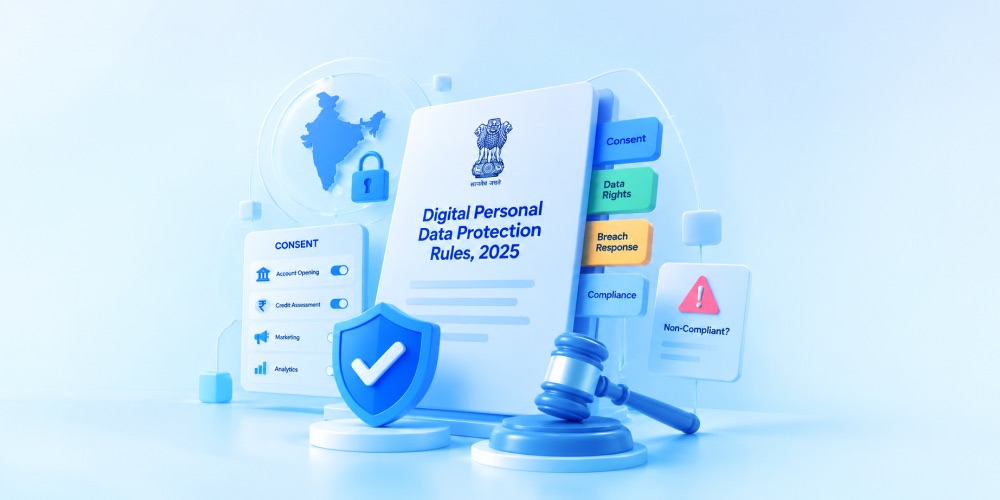
That's the date India's Ministry of Electronics and Information Technology notified the Digital Personal Data Protection Rules, 2025 under Gazette Notification G.S.R. 846(E) — the operating manual for the Digital Personal Data Protection Act, 2023, a law that had been sitting on the books for nearly two years without the machinery to actually enforce it. That machinery now exists.
If your business collects a customer's phone number, email address, physical address, or any other piece of personal data, this notification directly changes what "operating legally in India" requires of you. And unlike regulations that arrive with a single distant deadline everyone quietly ignores, this one comes with a clock that started running the moment it was published — parts of it are already enforceable today, not eighteen months from now.
This article walks through exactly what changed, what's live right now versus what's still phasing in, what non-compliance can actually cost you in rupees, and how to find out — honestly — whether your company already has a gap.
What Actually Happened on 13 November 2025
The Rules didn't appear without warning. The government released a draft version for public consultation on 3 January 2025, spent roughly ten months gathering feedback from industry and legal experts, and then finalized the text before notifying it. That gap matters: it means the final Rules reflect deliberate, considered policy choices rather than a rushed first draft — which is part of why regulators are widely expected to enforce them firmly, without a long informal grace period beyond what's written into the timeline itself.
The Rules operationalize the Digital Personal Data Protection Act, 2023, which Parliament had already passed but which couldn't be enforced without implementing rules spelling out timelines, formats, and procedures. With this notification, that gap has closed, and the official Rules text is now the reference document every compliance team in the country needs to be working from.
The Compliance Clock: What's Live Now vs What's Coming
This is the part most businesses get wrong — they assume the entire law flips on at a single future date. It doesn't. The Rules follow a phased rollout, and knowing which phase applies to you is the first real step in any compliance check.
| Provision | Effective From | What It Means |
|---|---|---|
| Data Protection Board (powers, procedure) | 13 Nov 2025 (immediate) | Regulator is live and can act on complaints now |
| Consent Manager registration | 1 year (~Nov 2026) | Consent intermediaries must be fully registered |
| Core Data Fiduciary obligations (notice, breach reporting, consent, security) | 18 months (~May 2027) | Deadline that applies to most businesses |
The 18-month runway exists to give organizations real time to rebuild consent flows, security practices, and breach-response processes properly — not to be treated as a reason to delay starting. A business that begins serious work in month 15 is racing a fully operational regulator with almost no room left to catch and fix mistakes. A business that starts now has over a year to get it right.
What Non-Compliance Actually Costs — In Real Rupees
This is the section most explainer articles skip, and it's the one that changes how seriously a leadership team takes the deadline. The Digital Personal Data Protection Act, 2023 sets out a Schedule of monetary penalties under Section 33, enforced by the Data Protection Board once it concludes an inquiry and finds a breach significant.
| Violation Type | Maximum Penalty | Typical Trigger |
|---|---|---|
| Inadequate security safeguards leading to a breach | Up to ₹250 crore | Weak access controls, no encryption, poor vendor checks |
| Failure to notify the Board/users of a breach | Up to ₹200 crore | Delaying or skipping mandatory breach reporting |
| Violations involving children's personal data | Up to ₹200 crore | No verifiable parental consent, ads targeting minors |
| Any other unlisted violation | Up to ₹50 crore | Catch-all category, still significant for smaller firms |
| Data Principal's own duty violations | Up to ₹10,000 | Rare; applies to individuals, not businesses |
A few details make this framework sharper than it first appears. These are fixed rupee ceilings, not a percentage of company turnover, and they're assessed per instance — meaning a single incident that involves both a security failure and a late breach notification can trigger two separate penalties stacking on top of each other. The Board does weigh mitigating factors, including how quickly you disclosed the issue, how you remediated it, and your prior compliance track record, so a documented compliance program directly and measurably reduces exposure. Orders can be appealed to the Telecom Disputes Settlement and Appellate Tribunal within 60 days, with a further appeal on questions of law available at the Supreme Court.
For context, even the "residual" ₹50 crore tier — the catch-all for violations that don't fall into a specific named category — is enough to seriously threaten a small or mid-sized company, even though it would barely register for a large enterprise. Compliance size doesn't scale down with company size; the exposure is flat.
Why "We'll Deal With It Later" Is a Riskier Bet Than It Sounds
Three specific features of the Rules make procrastination an expensive strategy.
The Data Protection Board already exists. For years, Indian data protection discourse treated enforcement as theoretical — a law on paper with no regulator behind it. That's no longer accurate. The Board's constitution and operating rules took effect on day one, meaning the institutional machinery to receive complaints, run inquiries, and impose the penalties above is already standing up while most businesses are still inside their grace period for other provisions.
Breach reporting has a real deadline, and building the process takes longer than people expect. Organizations must report a personal data breach to the Board without delay upon becoming aware of it, followed by a fuller report within 72 hours. That sounds workable on paper — until you try to build a workflow that can identify a breach, scope its impact, and produce a Board-ready report inside three days without a plan already rehearsed. That is not something you want to be designing for the first time during an actual incident, with the ₹200 crore late-notification penalty sitting on the table.
Retrofitting consent and notice systems is a bigger project than it looks. The Rules require consent notices to independently explain, in plain language, exactly what data is collected and why — not by reference to a separate policy document buried elsewhere. For businesses whose current "consent" is a checkbox next to a wall of legal text, this means rebuilding the actual user-facing data-collection flow, not editing a PDF.
A Quick Self-Check: Common Compliance Gaps
Run through this list honestly. If more than one applies, you likely have real work to do before your applicable deadline.
- Your privacy notice is a long-form legal document rather than a short, itemized notice a user can actually read in the moment they're asked to consent
- Withdrawing consent takes more steps or more time than giving it did
- You don't have a documented, rehearsed process for reporting a breach within a fixed number of hours
- You've never formally assessed whether your organization meets the criteria for a Significant Data Fiduciary, a status that carries materially heavier obligations, including recurring data protection impact assessments
- Your business processes any child's personal data without a defined mechanism for verifiable parental or guardian consent
- You don't have a designated, publicly listed contact point for people to raise data-related grievances
- Nobody in your organization could tell you, right now, which penalty category in the table above your business is most exposed to
None of these gaps are unusual — they describe how most Indian businesses have historically handled data collection, built up over years without a regulator actively watching. The point of this checklist isn't to alarm you; it's to convert a vague sense of "we should probably look into this" into a specific, addressable list your team can actually act on.
What Regulatory Scrutiny Typically Looks Like in Practice
Data protection enforcement rarely starts with a random, sweeping audit. It usually starts with a trigger — a breach that becomes public, a user complaint, or a sector-specific review by an existing regulator like the RBI or SEBI that flags a data-handling issue. Once the Data Protection Board is actively receiving and acting on complaints, an organization's compliance posture stops being an internal, private matter and becomes something investigated on the government's timeline, not the company's own.
This is exactly why businesses that treat the 18-month window as active preparation time — rather than a distant deadline to worry about later — tend to come out the other side in a stronger position, both operationally and reputationally.
Building a Realistic Compliance Timeline
A sensible approach doesn't try to fix everything in one sprint. A workable sequence looks like this:
- Map where personal data enters, moves through, and exits your systems. You cannot fix a gap you haven't identified, and most organizations are surprised by how many undocumented data flows they actually have.
- Classify your obligations. Determine early whether you meet the criteria for a Significant Data Fiduciary, since that status brings materially heavier and more frequent compliance requirements.
- Rewrite consent notices and flows so they meet the plain-language, itemized standard, and make withdrawing consent exactly as easy as giving it.
- Build and rehearse a breach-response workflow capable of meeting the 72-hour reporting timeline before an actual incident forces the issue under pressure.
- Document a grievance-handling process with a clearly published point of contact and a tracked 90-day response commitment.
- Revisit and repeat. This isn't a one-time project — the Rules expect ongoing internal audits, particularly for Significant Data Fiduciaries, on a recurring cycle rather than a single certification event.
The Digital Personal Data Protection Rules, 2025 didn't just add paperwork to India's compliance calendar — they gave the country's privacy law an actual regulator, an actual clock, and actual financial consequences running into hundreds of crores per violation. The 18-month runway is real, but it's a runway for organizations that start using it today, not a reason to set a calendar reminder for month 17.
If you worked through the self-check above and recognized more than one gap in your own business, that's not a reason to panic — it's simply the honest starting point that most organizations in India are working from right now. The difference between the companies that handle this well and the ones that end up in front of the Data Protection Board isn't luck. It's whether they started before the deadline forced them to.
FAQ
When do the DPDP Rules, 2025 come into force?
In phases — the Data Protection Board is active from 13 November 2025, Consent Manager rules apply from November 2026, and core business obligations apply from May 2027.
What is the maximum penalty under the DPDP Act, 2023?
Up to ₹250 crore per instance for failing to implement reasonable security safeguards.
Is the ₹250 crore penalty a one-time cap per company?
No — penalties are assessed per instance, so multiple violations from one incident can be penalized separately.
Does the penalty scale with company turnover?
No — penalties are fixed rupee ceilings set out in the Schedule, not a percentage of revenue.
Who enforces the DPDP Rules?
The Data Protection Board of India, which is already constituted and operational.
What must happen if my company suffers a data breach?
You must notify the Board without delay, followed by a detailed report within 72 hours.
Does the 18-month timeline mean I can wait 18 months to start?
No — it's preparation time; the Board is already active and can act on complaints today.
Can a small business be fined the same amounts as a large enterprise?
Yes — the penalty caps are flat and don't adjust downward for company size.
Is there a lower penalty tier for minor or unlisted violations?
Yes — a residual category caps at ₹50 crore for violations not separately specified.
Can penalty orders be appealed?
Yes — appeals go to the Telecom Disputes Settlement and Appellate Tribunal within 60 days.
Do children's data violations carry a separate penalty?
Yes — up to ₹200 crore for breaches involving a child's personal data or consent.
Does having a compliance program reduce my penalty exposure?
Yes — the Board considers self-disclosure, remediation, and compliance history when deciding the amount.
This article summarizes the phased implementation structure and core provisions of the Digital Personal Data Protection Rules, 2025 and the penalty framework under the Digital Personal Data Protection Act, 2023, as notified by the Ministry of Electronics and Information Technology. For the complete legal text, refer to the official Rules notification, the Act text, and the Press Information Bureau's official release. This is general information, not legal advice — consult a qualified professional for guidance specific to your organization.
See how ConsentCure gets you audit-ready before the DPDP deadline hits.
Book a Demo